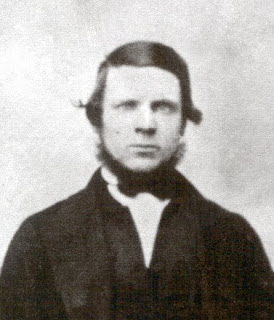
Sunday, December 9, 2012

Joseph Morris & Elizabeth Vernon


Elizabeth Vernon was bornin 1794 in Berwardley, Cheshire, England to George and Rebecca Goban Vernon. She grew up in Cheshire, England. At the age of 16, Elizabeth married a sailor names James Silverthorn. The couple had a son and named him James. Soon after the baby was born, James went to see and did not return.

Joseph Morris was born on 17 December 1795 in Berwardley, Cheshire, England to James and Hannah Morris. The family lived on a farm near the Silverthorn's home. Joseph met Elizabeth when he was 20 years old. The couple was married on 24 July 1815 in the parish church at Oswald, Cheshire.

After two happy years, Elizabeth's first husband reappeared. He had not been lost at sea after all. This must have been a hard and emotional situation. It was finally decided that James would take his son, James, and Elizabeth would stay with Joseph.

Elizabeth never heard from her son again.

Joseph and Elizabeth had a family of six children together, including William Morris. Elizabeth was an expert seamstress and made linings for the shoes Joseph made.

Elizabeth died on 10 October 1839 in Berwardley at the age of 45. She was buried at the Church of Dukinfield, Cheshire, England.

Joseph died 28 April 1861 at the age of 66 and was buried at St. John's Church in Dukinfield, Cheshire, England on 1 May 1861.


Sunday, December 2, 2012

William Rowley


William Rowley was born in 1784 at Grafton, Flyford Parish, Worcestershire, England.
There is some mixed information on his mother. There are records of his father being John Rowley (1754-1823) and his mother being Ann Hodges (1753-1825) or Ann Taylor (1760-?).
Nothing is known of his childhood, although it is believed that he did not have a formal education and wasn’t able to write. This belief comes from the fact that there is an ‘X’ following his name on his marriage license to Ann Jewell.
William married Ann Taylor in July 1807. The couple had 7 children between 1808 and 1827. William made a good living for his family in Mars Hill, Worcestershire, England which he owned. He had a nice home surrounded by orchards and fields of hops.
The family were well enough off to afford a governess for their younger children. The governess was a young woman named Ann Jewell.
 Ann Taylor Rowley died in 1835. Some of the older children may have been married and out on their own, but William would have been left with children ranging from about 8 to 27 years of age.
About 5 months later on 22 August 1836 in the Suckley, William married Ann Jewell.  At the time of their married, William was 51 and Ann was 28.
Marriage certificate. Note the X’s following the words, “The mark of William Rowley.”

The couple lived on Mars Hill for 10 or 11 years after their marriage and added 7 more children to his family. Their children are: Louisa, Elizabeth, John, Samuel, Richard, Thomas and Jane.
William and Ann were faithful members of a congregation known at the United Brethren. This was a group who had broken off from the Wesleyan Methodist church in search for more truth. In 1840, a Mormon missionary named Wilford Woodruff traveled to England and was prompted to go to Herefordshire where he found the home of John Benbow, another member of the United Brethren.  Eventually, all but one member of the congregation of over 600 were baptized.
William was baptized at the John Benbow farm on either 6 May 1840 (according to FamilySearch) or 24 May 1840 (according to the book Rowley Family Histories).
William received the Aaronic Priesthood and was ordained a deacon on 22 March 1841 by Wilford Woodruff in Stanley, Lancashire, England (Woodruff, vol. 2, p. 68).
The next few years, the family was active in the LDS Church and helped in its growth in the area. Elder Woodruff stayed with the family on at least two occasions, but possibly more. In the journal of Wilford Woodruff (vol. 1, p. 452) he mentions spending the night at William Rowley’s home.
According to the Millennial Star, a periodical published by the LDS Church, there was a general conference held in Manchester in April 1845 and in attendance were members from the Mars Hill Branch (Millennial Star, vol . 5, p. 167). According to family tradition, the Rowley home was often used for church meetings. The mention of the Mars Hill Branch may indicate that the Rowley home was actually licensed for the use of religious meetings, which was English law at the time.
Later that year on September 21, there was a meeting called the Mars Hill Conference which met “in the parish of Suckley, Worcestershire” (Millennial Star, vol. 7, p. 3). The Mars Hill Conference included 466 members from 11 branches.
One example of William’s faith comes from a story retold by his grandson, William G. Rowley.
This is a story my Grandmother, Ann Jewell Rowley told me when I was a small boy.
One night while Elder Woodruff was staying at their home, a mob of men came to their door and Grandpa [William Rowley] opened the door and asked them what they wanted. They said they wanted Woodruff, but they were told that Brother Woodruff had gone to bed. This did not satisfy them. They said, "We want Woodruff and we are going to get him!" Grandpa said, "If you get him it will be over my dead body." Members of the Mob then took hold of Grandfather and dragged him out into the yard where they beat him until he was unconscious. While the mob was dragging Grandfather away, he called to Grandmother [Ann Jewell Rowley], telling her to close and lock the doors, which she did. After they had beaten Grandfather until they were afraid he was dead and finding the house locked up, they departed being afraid to break into the house by force. When Elder Woodruff arose in the morning, finding [Grandfather] bruised and in bad condition, he advised them to sell out and move to America and to Zion (Rowley, Roberta Benson, History of William Rowley and Ann Jewell, pp. 3-4).”
As many other early members of the Church, the Rowley’s financial situation declined. In 1845 and 1846, their crops failed, forcing them to sell their home and all their possessions at public auction but a feather bed.
Another blow came to the family when a wagon tipped over onto William, which left him bedridden for a period of time. Some stories say that his leg and hip were crushed in this accident. William was in his 60s at this point. This injury, along with the anxiety over the family’s financial situation are believed to have contributed to his death although the copy of his death certificate (see image on right) states that he had "Influenza, Eight days." William Rowley died on 14 Feb 1849 at the age of 64.
William was buried 20 Feb 1849 in Suckley. (See record on left.) This left Ann widowed at the age of 48 and with sole responsibility over their 7 children, aging 7 months to 12 years as well as one of William’s daughters from his first marriage, Eliza, who lived with the family.
Eventually, Ann and her children made their way to Utah. Eliza also traveled with Ann Jewell but passed away at Sweet Water in Wyoming.

Ann remarried twice to good men who took care of her, but it can be easily assumed that she was always devoted to William. First, after the death of her 3rd husband, Luke Ford when she moved from Parowan to Huntington, Utah she went back to Ann Rowley. Also, the same day she was married to her Mr. Ford (14 Oct 1859), she also received her endowments and was sealed to William in the Endowment House in Salt Lake City, UT.

Sunday, October 7, 2012

Ann Jewell Rowley


Ann Jewell was born in December 1807 and christened at St.Andrew’s Church on 5 December 1807 in Worcester, Worcestershire, England. Here

William Jewell and Frances Green. Ann’s mother died the same month of Ann’s birth and William remarried a woman named Sarah Hyde. Many records refer to Sarah as Ann’s mother and she did raise her, but was not her biological mother.

As a young adult, Ann was employed as a governess to William and Ann Taylor Rowley, who lived in Suckley, on a piece of land known as Mars Hill. Ann Taylor passed away in 1835. The youngest of their 7 children would have been 9 or 10 years old.

On 22 August 1835 in the Suckley, William and Ann Jewell were married. Their marriage certificate indicates that neither William nor Ann could write due to the ‘X’ following each of their names. We can assume from this that Ann was not formally educated and may not have been able to read.
 
William and Ann's marriage certificate

The couple continued to live at Mars Hill for the 10 or 11 years. The couple bore seven children from 1837 to 1848.  Their children are: Louisa, Elizabeth, John, Samuel, Richard, Thomas and Jane.

In 1840, a missionary from the LDS Church named Willford Woodruff, traveled from Missouri to England. After praying for guidance, Elder Woodruff made his way to a remote farm in Herefordshire, England to the home of John Benbow. Benbow was a member of a congregation of over 600 men and women who had broken off from the Wesleyan Methodist church. They called themselves the United Brethern and were searching for truth. Eventually, all but one member of the congregation were baptized into the LDS church.  Among the congregation were William and Ann Jewell. (Click HERE to read an article about the conversion of the United Brethren.)

According to Willford Woodruff’s journal, Ann was baptized 6 May 1840 and William was baptized 24 May 1840. 

The next few years, the family was active in the LDS Church and helped in its growth in the area. In fact, their home was likely to be licensed for the use of religious meetings. Elder Woodruff stayed with the family on at least two occasions, but possibly more.

As many other early members of the Church, the Rowley’s financial situation declined. In 1845 and 1846, their crops failed, forcing them to sell their home and all their possessions but a feather bed.

William died February 15, 1849 at the age of 64 in Suckley, possibly to complications from a wagon accident a few years earlier which may have left him bedridden. Ann may have been providing for the family prior to his death, but at the time of his death was left with sole stewardship over her 7 children, whose ages at the time ranged from 7 months to 12 years as well as her step-daughter Eliza, age 25, who lived with them.

In Ann’s autobiography is says: “I was very grateful for the gospel of Jesus Christ and the comfort it gave me. I knew that our parting was only temporary and that viewed from the eternities, this was but a fleeting moment.”

The next 7 years in England must have been a hardship. Ann was an accomplished seamstress and worked with the help of her older daughters on items they could sell, although there was some prejudice in the community toward her due to her religion. Louisa, the oldest daughter, worked as a maid in her teens and the John and Samuel were sent to work at a brick kiln at the ages of 9 and 7 located several miles from home.

Ann’s brother Thomas Jewell and her sister, Sarah, provided some help to the family, as well as a few shillings a week from the parish “poor fund” but her desire to join the members in America must have continued to grow during these trials.

As the years went by, fear of John being sent to war and Louisa falling in love were more reason for Ann to get her family to America. It took the Perpetual Emigration Fund (PEF) to accomplish this goal. The PEF was started in 1849 and was a fund that the LDS Church created and members donated to in order to help members in Europe to emigrate to America. Those who took money from the fund were to pay back what they could over time.

On 1 May 1856, Ann Jewell Rowley (46) although with her 7 children and step-daughter Eliza, boarded the ship Thornton in Liverpool, England. James G. Willie was called as president of the “company” of 764 Latter-Day Saints by Elder Franklin D. Richards. Their 6 weeks journey was relatively calm. The Thornton docked in New York City on 14 June 1856.

After several steamboat and railroad trips, the company made its way to Iowa City on the 26th of June. By the 15th of July, their company, now known as the Willie Handcart Company, started their 1300 mile trek to Salt Lake City, Utah.

By this time, Ann’s children’s ages ranged from 19 to 8 years old. Everyone over age 7 was expected to walk. The company generally woke at 4:30am and left camp by 7:30am. On average, they traveled 14 to 17 miles a day. Due to many circumstances, the company was met with much hardship.

Ann’s autobiography says: “Handcarts had to be made, supplies gathered, oxen caught and broken to pull the heavy supply wagons, everything that even hinted of being a luxury must be eliminated. There were many keepsakes that I wanted to take, but couldn’t. But there was one thing I didn’t consider a luxury and that was my feather bed. I had hung onto that beloved item from the time of the auction in England and now clearly there was no room for it. It wouldn’t be bad to walk 1300 miles if one had a feather bed to sleep on at night, but no matter how I folded it, it was too bulky. Wouldn't it be just wonderful, I thought, if I could deflate it in the morning and inflate it at night, so it would pack compactly. But a feather bed is a feather bed and when it came to choosing between Zion and a feather bed, well it was a little too late to turn my back on Zion, so I ripped it open and emptied the feather on the ground and used the tick to cover the supplies on the handcart.”

Ann’s autobiography says: “Our handcarts were not designed for such heavy loads and we were constantly breaking down.  They had been made of green lumber and were affected by the weather.  Rawhide strips was used to wrap the iron rims to the wheels and the wood would shrink and the rawhide would come loose.  It hurt me to see my children go hungry.  I watched as they cut the loose rawhide from the cart wheels, roast off the hair and chew the hide." 

She continued: "There came a time, when there seemed to be no food at all.  Some of the men left to hunt buffalo.  Night was coming and there was no food for the evening meal.  I asked God's help as I always did.  I got on my knees, remembering two hard sea biscuits that were still in my trunk.  They had been left over from the sea voyage, they were not large, and were so hard, they couldn't be broken.  Surely, that was not enough to feed 8 people, but 5 loaves and 2 fishes were not enough to feed 5000 people either, but through a miracle, Jesus had done it.  So, with God's help, nothing is impossible.  I found the biscuits and put them in a dutch oven and covered them with water and asked for God's blessing, then I put the lid on the pan and set it on the coals.  When I took off the lid a little later, I found the pan filled with food.  I kneeled with my family and thanked God for his goodness.  That night my family had sufficient food. “

Ann’s step daughter, Eliza, died on the way to Salt Lake and was buried along the trail. Eliza was frail before the trek began but she traveled from Liverpool, to New York and on to Iowa City. She walked nearly a thousand miles to get to Zion with part of her family. Surely it was a sacrifice for her to leave her other siblings, and I am confident that she has been rewarded for her devotion to the gospel of Jesus Christ.

The family entered the Salt Lake Valley on 6 November 1856 and were given shelter and food. Ann had a piece of sagebrush in her eye that needed attention. The family was split up and sent to different homes so there would be less burden on the Saints in Salt Lake. Ann, Samuel, Thomas and Jane were soon sent to Nephi where the ward provided for them, although Ann did not like accepting charity and wanted to pay her immigration fee as soon as she could.  Not wanting to burden others or live off of others’ labors, Ann and Samuel dug a room in the side of a hill where they lived through the winter. This is according to family tradition. During this time, Ann took in sewing and Samuel worked for several farmers.

In the Spring of 1857, a man named Andrew Baston, of Parowan, UT, came to the bishop in Nephi to ask if there was a woman who would make a good wife. Bishop Bigler introduced Andrew and Ann and “it was as simple as that,” Ann said. “He needed a wife and I needed a home for my younger children, so we were married within a few days. Andrew was a fine man.”

Andrew paid Ann’s debts and provided a good home for her family. He died less than a year after their marriage. Ann said, “I was grateful to the Lord for having sent Andrew to me. I know I was a comfort to him, that last year of his life. He left me well provided for.”
 
On 14 Oct 1859, Ann made her way to Salt Lake and was sealed to William Rowley in the Endowment House.
 
Ann married again to a man named Luke Ford who took care of her until his death.
 
1860 Census showing Luke Ford (70), Ann (52),
Samuel (17), Richard (15), Thomas (14) and Jane (12) and Parowan, Utah.
In her later years, Ann lived in Huntington, UT where several of her children lived.

This valiant pioneer died in 1888 and was buried in the Huntington Cemetery.

 Click HERE to see Ann's headstone on Find A Grave.


Click HERE to preview the book: Rowley Family Histories, a history of William & Ann Jewell Rowley and their children.

Click HERE to see information on ordering your own copy of Rowley Family Histories.


Click HERE to read Ann's Autobiography from Some Early Pioneers of Huntington, Utah and Surrounding Area, by: James Albert Jones compiled in 1980.


Sunday, September 30, 2012

Sarah Durham


Sarah Durham was born in Oldham, Lancaster, England to John Durham and Isabella Thompson on 6 June 1825.

John, about 35 years old (1835) and Isabella, nearly 90 years old in about 1880.

When Sarah was still young she worked in the Nottingham cotton factory which was famous for its lace.

Sarah was baptized a member of the LDS church on 18 June 1843. One brother joined the church as well, but the rest of her family was devastated.

Sarah married William Morris on 2 August 1848 in St. Johns Church in Failsworth. Both were Mormons at the time and may have decided to be married at St. Johns to please their families.


In 1862, Sarah, William and 6 of their children made their way from England to Parowan, Utah. One daughter, 10 year old Sarah Jane, passed away of Mountain Fever in Wyoming and was buried on the roadside. (See William's history for more information on their journey.)

Sarah was the mother of 9 children (including William T. Morris), but lost 4 while they were young. One baby was buried in England before they came to America, Sarah Jane and twin boys, Joseph and John who both died of Cholera Infantum at 10 months of age.

Sarah grew up in a well-educated family. The family was also very talented in music. Sarah couple sight-read and sing in a rich alto to even the most difficult music. She was a member of the Parowan Choir, a prestigious group lead by her brother, Thomas Durham.

William and Sarah were sealed in the St. George Temple on 13 March 1870.

William and Sarah in about 1900. Will would die in November of that year.

Sarah has black hair and black eyes. She had a quick mind and a quick tongue. She was active in the Church and active in the community, including politics.

At 5 feet tall and less than 100 pounds was known as "Little Grandma" to her posterity. One evening when she was past 80, her son was playing a lively song on the piano. She came from her room with a little lampshade on her hear. She held out her skirts and danced like a little girl.

Sarah was remembered as an excellent cook and immaculate housekeeper. Her home was full of flowers and other lovely things.


This valiant pioneer died on 3 July 1916 in Parowan, Utah at the age of 91.

Click HERE to see Sarah's gravestone on Find A Grave.

To see Sarah on the 1880 and 1900 census, see William's post.

Tuesday, September 18, 2012

William Morris


William Morris was born 16 November 1820 in Burswardsley, Cheshire, England to Joseph Morris and Elizabeth Vernon.

William's father was a shoemaker. In his early 20s, William began working in the coal mines at Failsworth. He eventually became foreman of the mines.
William was baptized on 1 May 1842.


William married Sarah Durham on 2 August 1848 in St. Johns Church in Failsworth. The couple moved to Dukinfield where they opened a little shop. The business did very well and they were able to provide for their family.


Between 1849 and 1866 the couple welcomed 9 children to their family.

William and Sarah were both baptized into the LDS Church before their marriage. After 14 years, they saved enough money to join the Saints in America.

In 1862, the couple and 5 children traveled from England to Utah. William carried their ailing baby, William T., nearly the entire trip. The family sailed from England on the Mancester.

William and his family on the register for the ship, Mancester.


The company which the family traveled with made their way from New York, into Canada, to Chicago, the St. Louis and finally to Florence, Nebraska where they were met with ox teams to take them to Utah. From Florence to Salt Lake they traveled with the John R. Murdock company. The family, minus one, arrived in Parowan, UT on 10 October 1862. Their daughter Sarah Jane died in Wyoming of Mountain Fever and was laid in a lonely grave by the roadside.

In Parowan, William also became sick with a fever and an Indian known as "Doctor Bill" performed ritual ceremonies and prayers for him. William always believed that this saved his life.

At 44, William was called to help establish a settlement at what is now Panquitch, UT. Walking on snowshoes from Panquitch to Parowan for supplies, he became "snow blind" and later completely lost his sight after cataract surgery.

He and a neighbor, William Wilcock, also blind, would often walk together. One day they missed a bridge and fell into a creek. William laughed and said, "If the blind lead the blind, they both fall in the ditch."

William and Sarah were sealed in the St. George Temple on 13 March 1870.


1880 Census

1900 Census

1900
William died in Parowan, in the home he built, on 5 November 1900 at the age of 80.

He was remembered as kind, gentle man, a good farmer, shoe maker, church worker, town builder, and neighbor. He had red-brown hair and deep blue eyes. His son, William T., said, "I loved to be with my father...a more honorable, upright man that my father cannot be found."


Click HERE to see William's gravestone on Find A Grave.

Wednesday, September 5, 2012

"My Tobacco Money"


When I was about 16 years old a lot of the boys with whom I chummed began to use tobacco and they tried to get me to smoke or chew with them, but I had always disliked the tobacco habit so I told them they could smoke if they thought it would do them any good, but I was going to take the money they would spend for tobacco and put it in a fund and buy books with it. I asked several of them how much they spent a week on tobacco and took an average of the lot and laid that much away each week until I had accumulated a nice little sum which I spent for a set of books consisting of 16 volumes containing information of various topic that were very useful to me. I continued this until I had secured quite a little library. One Christmas day when the band of which I was a member came to our home to serenade, as was one of the good old customs, now nearly done away with and very seldom heard of. My uncle took occasion to show the members my library and told them that was bought with my tobacco money. They asked if I had been selling tobacco. "No," said my uncle, "He has stopped the sale as far as he is concerned. These books represent the money he would have spent if he had followed the fashion and been a smoker."

By William T. Morris

Wednesday, August 29, 2012

William T. Morris


William Thomas Morris was born in Dukinfield, Cheshire, England on 17 May 1861 to William Morris and Sarah Durham. He weighed 11 lbs when he was born. Father William was a farmer and later was a coal miner. He was a baby as his family traveled from England over the sea and across the plains to settle in Parowan, Utah.


Parents, Sarah and Will
The family traveled from Liverpool to New York on the Mancester.


William T. with his parents and siblings on the register of the ship, Mancester.


They traveled to Florence, Nebraska (now Omaha) and then from there to Utah in the John R. Murdock company. His father, William, carried his one year old son most of the way. Baby Will was not well most of the trip, but made it safely with his family on 10 October 1862.

While in Florence (before leaving with the ox team en route to Salt Lake), Will learned to walk. Will was the only young child in that company who survived the trek, except for a few babies who were born on the way. His sister Sarah Jane died in Wyoming of Mountain Fever.

When on their trek to Utah, Will’s mother sang to him and she nursed him. One day, he threw back his head and sang the whole lullaby back to her. She was startled and a little unnerved at the experience, but it was a sign of the influence that music would be in William’s life. He eventually sang and played the violin very well.

Will had 5 sisters, all born in England, and three brothers, each born in Parowan. Of this family of 9, four died before adulthood. One baby sister died in England, Sarah Jane who was 10 years old when she died on the plains, and twin brothers who died of Cholera when Will was three. One of his first memories was of his mother setting him onto her lap and weeping bitterly after burying the last baby.

When Will was a boy, President Brigham Young was on his was to St. George and stopped in Parowan to attend a meeting. President Young asked Will’s uncle, Thomas Durham to sing. Will remembered the Prophet standing with his elbows on the pulpit during the song.

Will started school at 7. At 10 he started his first job in a lath mill. This may have started his love for working with wood. In his later years, he made and sold inlaid furniture so well made that the joints could not be detected by the eye or the hand.

At 13, Will joined the Sunday School Choir. He sang alto with the girls until his voice changed, when he started singing tenor, and he didn’t care when the other boys teased him about it. He did so well in this choir that he was asked to sing in the ward choir. Later in life, Will and his wife sang quartets with William T. Jr. and his wife and were invited all over Southern Utah to sing.

Will was baptized on 22 July 1877 when he was 16 years old. "He had gotten the idea that it would be a most awful thing to do anything wrong after being baptized and didn't want to be baptized at 8. So his wise parents waited patiently until he was ready." Will also took our his own endowments at 16.

At this time Will learned to shear sheep and was making good money. With his earnings, he bought his first real violin. Previously, he had been teaching himself to play on a toy violin. He had aquired this toy from a friend in a trade. Toy violin for a pocket-full of marbles. Sensible little Will made a good trade that day.
William on the 1880 census with his parents.
William and O’Lena Christina Mortensen were friends growing up and their friendship grew over the years. They were married in the St. George Temple on 24 March 1882 when Will was 20 and Lena was 18.

1887

The couple had their first 2 children in Parowan: William T. Jr (1883) and Anders Marion (1885). Then the family moved to Colorado where Lena’s siblings and mother had lived for almost 2 years. (See Lena’s post for more information.)

In Colorado, the Morris family found the land to be uninviting but soon made some precious associations. The family introduced the May Day celebration to the San Luis Valley. Also, Will played his violin for dances, weddings, and funerals, was involved in choirs and he acted and directed community productions.

Five more children were born to Will and Lena while they lived in Colorado: Lena Isabella, known as Isa (1888), Cora May (1890), Earl Raymond (1893), Una Millicent (1896) and Alfred Serenus (1899).

Anders was not well since the family left Utah and in 1895, he became ill with pneumonia. Just a few weeks after he turned 10, Anders died and was buried in Sanford, CO.

In 1900, the family experienced another shock when Will suffered a severe heart attack. He was told that he needed to live in a better climate. The family was grateful that he was alive. He and teenage Isa took a train back to Utah and Lena stayed behind to sell their home and belongings in order to get enough money for the rest of the family to travel to Utah.

Back in Parowan, the family needed a home. Will accepted his parents’ offer to build an addition onto their home so the family could be close. Will’s father William was blind and in his 80s at the time. Will made adobe bricks out of clay with the help of his daughter Isa.

1900 Census in Parowan shows William and his daughter Isa.


1900 Census in Colorado also shows William and Isa with the rest of the family although both census records were recorded in June of that year. Lena must have had them add Will and Isa although they were in Utah.


1900 Census, cropped.


In Colorado, Will had done anything he could to earn money for his family. He did field work, mill work, and contracting. He even did some carpentry work for a man named Fred Meyer who owned a couple of big stores in New Mexico. Back in Utah, he did the same. He also was hired on occasion as a professional musician for extra money.

At this time, Parowan was almost totally democratic, politically. Will decided to run for County Clerk on the Republican ticket. He put together a singing group and went through the county campaigning to music. He won the election and remained in the job for 12 years. He was the third County Clerk in Iron County after Utah became a state. The steady income allowed the family to get out of debt and to begin to invest in the future.

Their last child, Angus was born in Parowan in 1903.


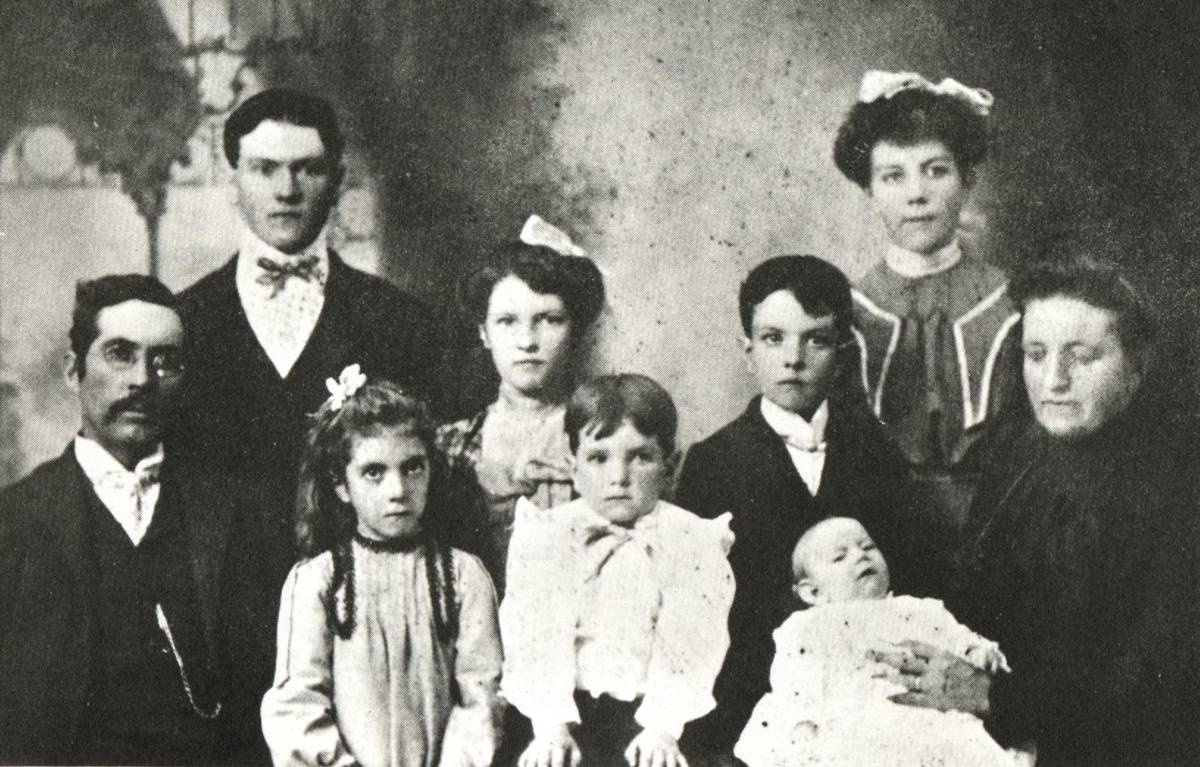
Morris family in 1903.
Rear: Will Jr., Cora, Earl, Isabelle.
Front: Will, Una, Alfred, Angus, Lena.


In 1904, Will bought 115 acres of fenced land with a house, a barn, and a flowing spring for $350. He and his boys Will and Earl worked every spare hour they had to clear, plow, sow, cultivate and harvest the land. They drilled a well and made a holding pond for irrigation water. Eventually they bought more land and worked it. Lena and the girls kept the house and helped with chores on the land. Over time the farm prospered. They also raised dairy cows and sheep.

This was a very busy time for Will. He was working eight hours a day as County Clerk and at least that much more on the farm five days a week. Saturdays he worked on the farm from dawn to dusk. He also was still involved with his music. He played his fiddle with an orchestra, taught music lessons occasionally and had many music related callings at church as well as other leadership positions.


Will and Lena in 1907
Will still had some heart “spells.” He would put a nitroglycerin pill under his tongue and wait. When the pain subsided, he would rest for a time and then go back to work.


1910 Census


In 1912, Will chose not to run for County Clerk reelection. The farm was prospering and the family was growing up. He was enjoying teaching music and found that it was too much. He took the position of Assistant County Clerk to help train the new clerk.
In August of 1912, Will and Lena’s son Earl died in an accident while working at the sawmill in the mountains above Parowan. He was 19 years old.

In June of 1913, Will was returning a cultivator to a neighbor when a sudden storm came in. Rain was falling so heavily that he had to stop the team and wait for a few minutes. When he started again it felt as if someone had hit him on the head with a club. He thought to himself, “That settles it.” When he came to, he was lying in the mud in the road. The wagon’s wheels had passed over him and the team was a quarter of a mile down the road. He struggled to get up but finally did. He got the horses , returned the cultivator to its owner and went home in pretty bad shape.
He had been struck by lightning and for years afterward, Will could tell when a thunderstorm was coming by the ache in his head.

Christmas was always special to the Morris family. Lena grew with Danish traditions and Will with English traditions. The family got the best of both worlds. It was a time for family and Blue Bell Farm was the gathering place and many families would stay overnight for several days.

The winter of 1919 was very cold. In fact, two feet of snow had fallen early in the year and did not completely melt until late spring. That was the year of the flu epidemic. Lena caught the disease and became very ill. One morning, after Will have been out all night caring for the animals, Lena voiced her concerns about Will wearing himself out. She had never wanted to sell the farm until then. They sold the farm for $24,800.


1920 Census
They used some of the money to visit friends and relatives in the San Luis Valley and then stayed with relatives in Mesa from November 1920 to May 1921. Angus was the only child at home and this point and he went to high school in Mesa that year. In the warm climate, Lena’s health improved.


Back in Parowan, the couple was looking forward retirement. On August 24, 1921, Bishop Hugh L. Adams asked them to serve a mission in the St. George Temple. They accepted and began work there five days later.

One of the first things Will did at the temple was work for his two sons who had passed away.


Within a few months of their temple service, Lena became ill with pneumonia. Although it seemed she was recovering, she passed away on 4 February 1922. Will stayed with relatives for a short time but his family could find no way to comfort him. So, he returned to the temple where he found some sense of peace.

Will: "Then for the first time I realized how utterly helpless and alone a man can be when his life's companion is taken away from him."

In the temple, he was reacquainted with Wilhelmina Cannon Sullivan, a friend of Will and Lena’s and Temple Matron when they served together. This friendship quickly turned to an engagement. They were to be married in October but when they spoke to Mina’s father, David H. Cannon, who was also the Temple President at the time, he simply asked, “Why not now?” The couple married in May 1922 in the St. George Temple.


This attachment may have been helped along by Lena herself. During her battle with pneumonia, Lena told Will that if anything should happen to her, he was to take care of Mina.

Mina had three children from a former married. At this time they were 23, 20, and 17 years of age. All three were sealed to Mina and Will on their wedding day. The families were close throughout their lives. In fact, Will’s son Alfred married Mina’s youngest daughter in 1923.

Will lived in the “Cannon Home” in St. George from 1922 to 1944. Will and Mina purchased the home from her father with the stipulation that her father live there and consider it his until after his death. Mina was delighted because she and her three children had all been born in that home.

David H. Cannon died of a heart attack on 24 December 1924. His new son-in-law, Will, held him in his arms as he died.

The couple had almost five happy years. Mina died 22 March 1927 due to kidney problems.

Again, Will was alone. All the children were married and settled. A man with a great capacity to love and be loved, Will was alone and desolate. Again, he could peace in the temple. Work there as well as music helped filled the emptiness that he felt for the next year.

One day as Will was working at the Doorkeeper at the temple, he took the recommend of a lady from Paragonah. Her name was Eliza May Robinson. She continued to come to the temple and they became better acquainted. Eliza was 56 year old woman who had never been married. When Will asked her brother if he thought she’d be interesting in “going out” with him, her brother told him that Eliza ran away every time a man came to the house.

Will and Eliza were married in April 1928 by George F. Whitehead, the Temple President. For the next 18 years, Eliza May gave Will all the love and affection she had.


On 2 September 1929, Will was appointed Assistant Temple Recorder. Six months later, on 25 March 1930, he was made Recorder. He held that position for almost seven years.
In 1935, Will became seriously ill. He was in bed for three months and unable to feed himself for seven weeks. He attributed his recovery to Eliza May and her constant care.


In 1941, Will suffered a severe heart attack that kept him in bed for several weeks. Again, Eliza May nursed him back to health. This attack, however, was the beginning of failing health that would plague him for the rest of his life.
Will had always had a workshop next to the house, where he did beautiful woodwork. As he was recovering from his illnesses, he found himself working in the shop more and more. During this time, he and Eliza May also enjoyed several vacations.


Four generations in 1943: William T. Morris, daughter Cora,grandson G. Morris Rowley and great-granddaughter Audrey Lorraine.


In 1944, Will sold the “Cannon Home” and bought another home. It was renovated before they moved in and Will immediately set out building a new workshop where he worked until the last few weeks of his life.

As a baby, Will was almost too frail to make it across the ocean and the plains, but his body grew into a strong, industrious man who lived to within a month of his 85th birthday. William T. Morris died 18 April 1946 in St. George, Utah. He was buried on April 22nd in St. George, Utah.
William's death certificate. There is a note that 14 days before his death, a doctor removed a mass from his neck, but he died of intestinal obstruction.


Obituarty


Eliza May lived another two years.

Grandson, Richard M. Rowley wrote:
“Grandpa Morris was always up with his times or ahead of them. He read novels and collected them…New gadgets intrigued him. He had the first folding Kodak camera I ever saw. In his workshop, along with his old wooden joiner’s plane were power tools of many kinds. He owned a typewriter at a time when they were not household items…He engaged in many activities straight-laced people of his time frowned on [including] play-acting and popular music…He even published a popular song, "Marching to Victory."

“But as much as he enjoyed the things of the world, he kept his perspective. He used his musical talents to praise the Lord and to promote the highest human virtues.”


Click HERE to see William's headstone on Find A Grave.